

SUMMER POUR (Part 1: Milfoil, Maine, Summer 2023)
A friendship-based papermaking project, co-created annually with a rotating constellation of people, plants, and places. Centering skill-sharing and nurturing between people and plants, the project asks to reconsider and reshape the roles of integration and intimacy within a rigorous collaborative art practice.
Summer Pour was Founded by Milcah Bassel
Summer Pour: Part 1, Co-creators Milcah Bassel and Patricia Brace
Collaborators: William O Valdes, Ziv Steinberg, Grace Brace, Chris Hayden.
Fibers:
Milfoil, Abaca
Dedication: This project is in loving memory of Stacey Leigh Kemp who believed that with confidence, you could do anything. (June 9, 1965 - March 26, 2023)
For the inaugural Summer Pour, multidisciplinary artist and papermaker Milcah Bassel collaborated with performance artist (and amateur ecologist) Patricia Brace, a long-time friend and collaborator, at Lake Arrowhead, Maine. Known for the presence of three invasive aquatic species—Water Milfoil, Swollen Bladderwort, and European Naiad—Bassel and Brace chose to work with the most abundant: milfoil.
Initially removed from Lake Arrowhead by a DASH harvesting boat, the milfoil was later collected by Brace from a large compost pile on land. The material was then cleaned, dried, and briefly cooked with soda ash before being processed into pulp in a Reina beater by MFA candidate Will O Valdes, under Bassel’s guidance. To supplement and strengthen the milfoil pulp, Valdes also processed abaca—a durable and reliable papermaking fiber derived from the inedible banana plant, sourced from Carriage House Paper in Brooklyn, New York.
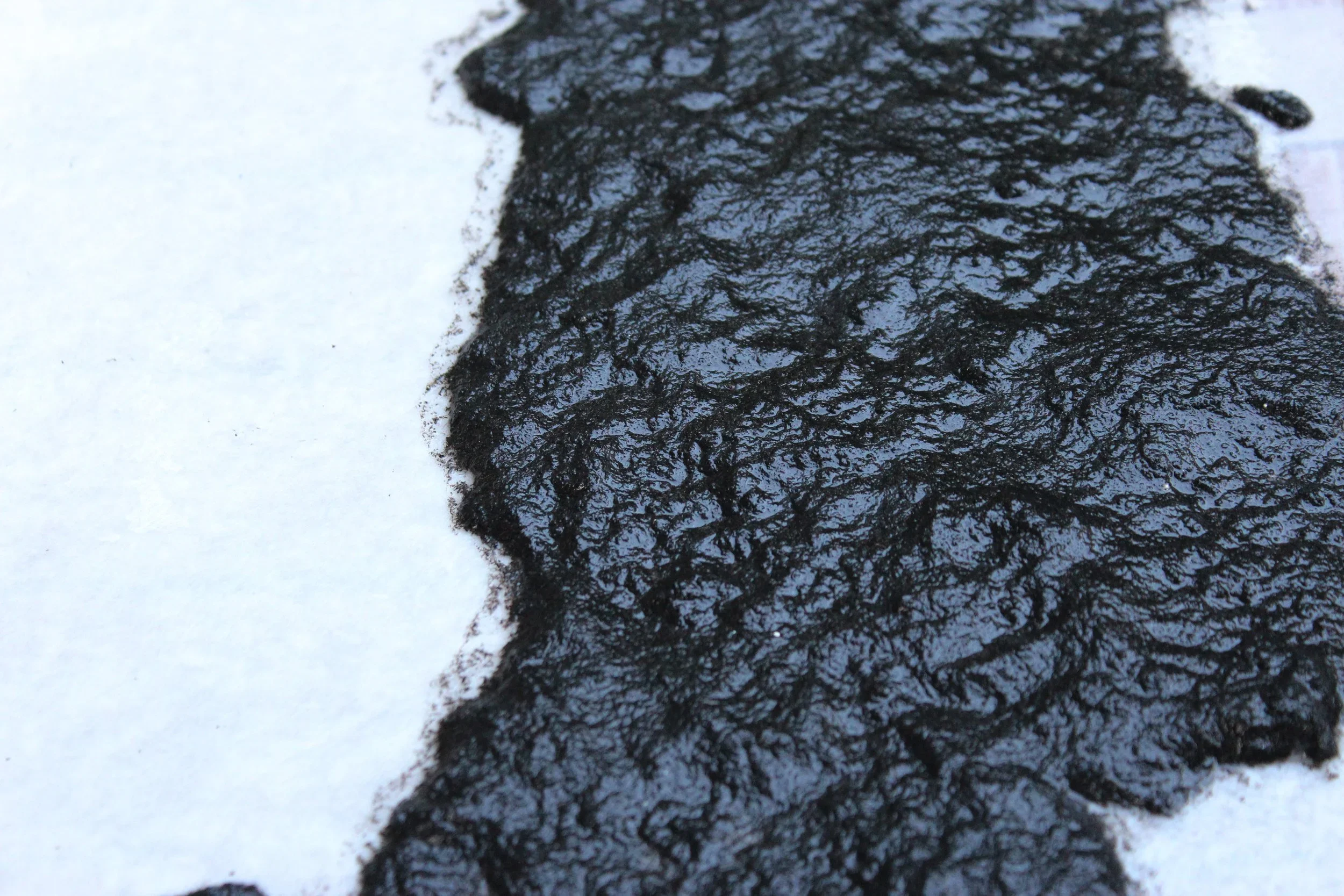
Using a handcrafted pour mould and rudimentary equipment, the pulped fibers were formed into large sheets of paper. Brace and Bassel worked alongside Ziv and Grace to form the sheets, experimenting with texture, layering, gradients, and composition. Although constrained to a single day of sheet formation, the process yielded numerous discoveries—most notably, the distinctive natural black fiber produced by the milfoil.
The sheets were either board-dried or air-dried, resulting in eight unique works, each measuring 28 by 32 inches.